Android / llama.cpp / GGUF
LLM AI Server with llama.cpp
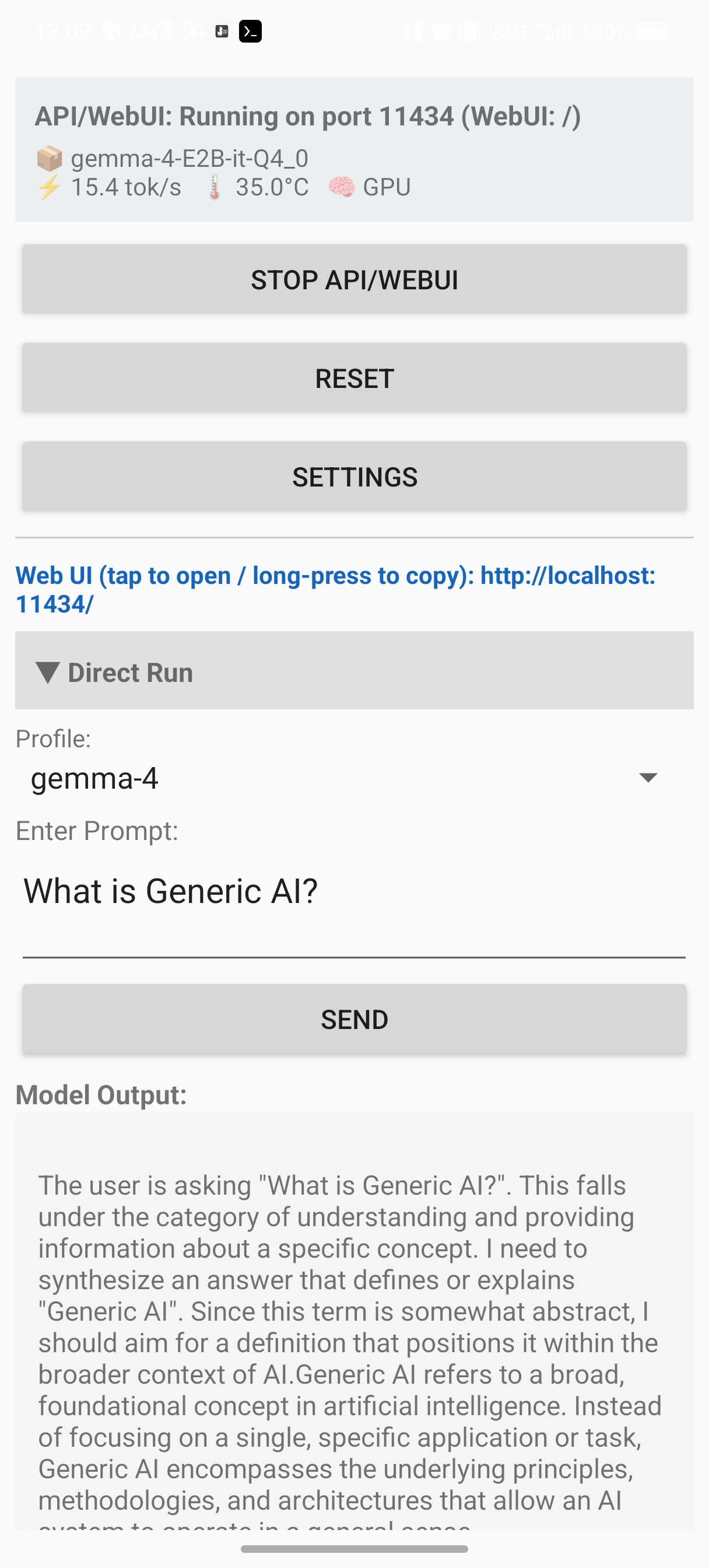
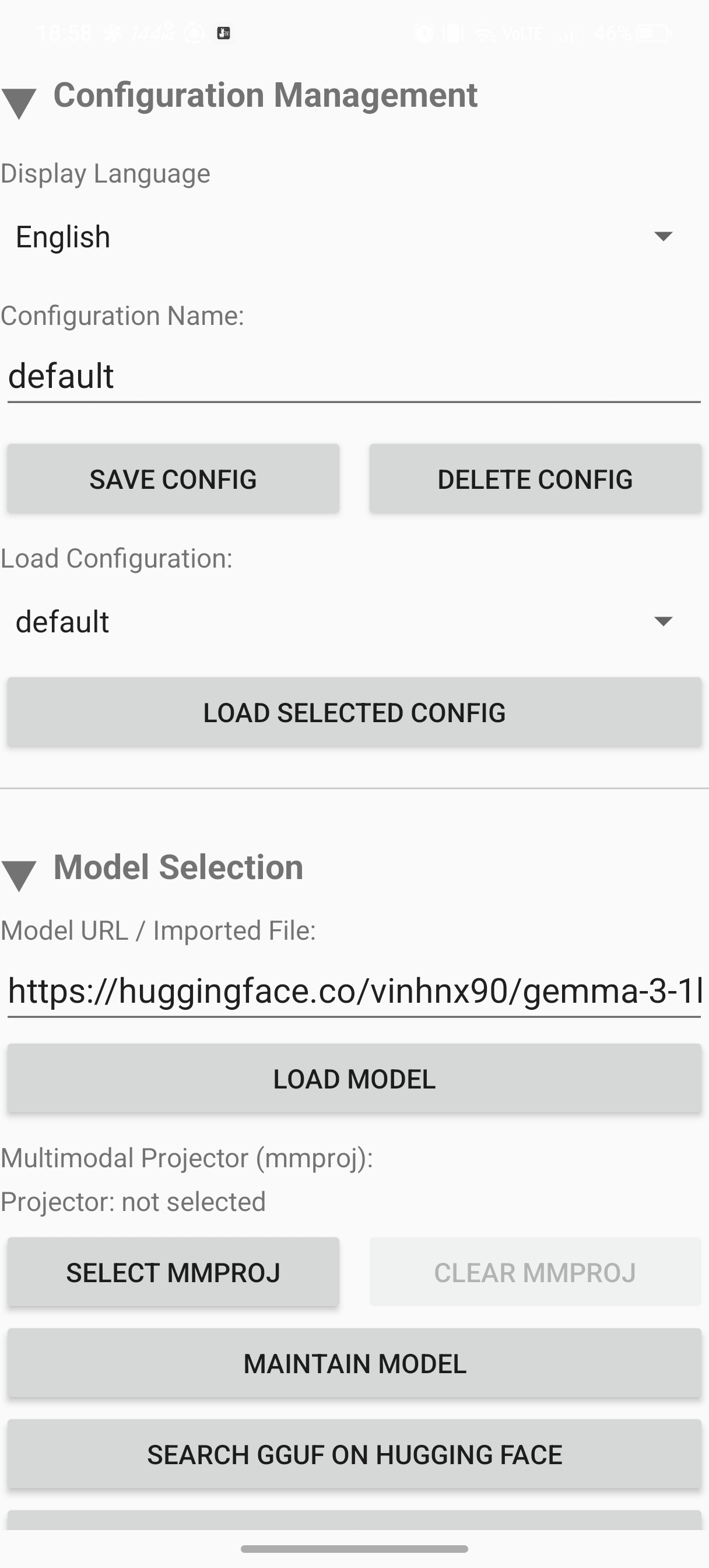
LLM AI Server with llama.cpp is an Android local-LLM testing app that lets you load GGUF models, tune inference and prompt-template settings, manage shared MCP / Function Definitions settings, inspect logs, and expose an Ollama/OpenAI/Anthropic-compatible API plus the bundled WebUI from one app.
Docs: User Manual | API Reference | Technical Specification | llama.cpp / JNI / CMake Deep Dive | Privacy Policy
- Supports both model downloads from a URL and importing local
.gguffiles from the device. - Lets you combine generation settings, Think behavior, custom chat templates, shared MCP settings, and Function Definitions JSON.
- Can start an on-device Ollama/OpenAI/Anthropic-compatible API and WebUI on the same port, including endpoints such as
/api/chat,/v1/chat/completions,/v1/completions, and/v1/messages.
Screenshots
Key Features
- On-device local inference: Runs GGUF models directly on Android with llama.cpp.
- Flexible model loading: Supports downloadable model URLs and local
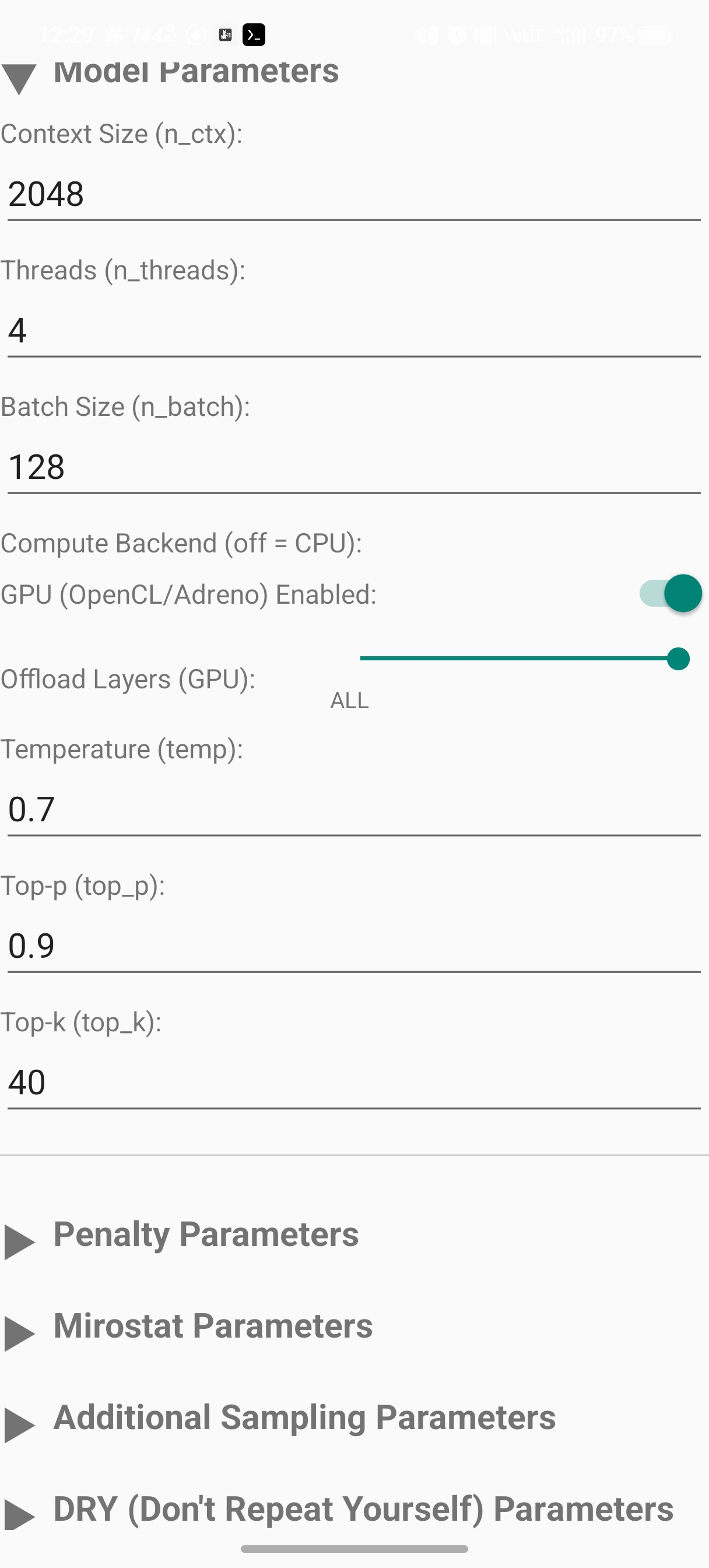
.ggufimports. - Deep inference controls: Adjust
n_ctx,n_threads, compute backend (CPU / GPU), offload layer count, Top-p, Top-k, penalties, Mirostat, DRY, Think behavior, and custom chat templates. - Vision & automatic context expansion: The default vision model is Qwen3-VL. If an image or long prompt exceeds
n_ctx, the app auto-expandsn_ctx(within device memory) and reloads; if it still does not fit, API clients get a proper server error. GPU init failures fall back to CPU automatically. - Smarter model search: The in-app Hugging Face search filters by model name, parameter size and quantization via pull-downs (each with a one-line guide), shows a device-suitability rating, and can download mmproj (projector) files directly.
- Upgraded inference engine: Updated to llama.cpp b10621 (v0.3.0) / ggml 0.22 — newer model support and Adreno OpenCL GPU.
- MTP speculative decoding (experimental): For models that embed an MTP head (Qwen3.5-MTP, Gemma 4, etc.), enable MTP (draft-mtp) per model profile. Off by default, adjustable
n_draft, no extra file needed (own head). Generation can be faster on supported setups. - Shared MCP / function-calling settings: Save MCP Config JSON and Function Definitions JSON separately from model profiles, then optionally enable them for the main prompt input,
/api/chat,/api/generate, and/v1/chat/completions. - Built-in Ollama/OpenAI/Anthropic-compatible API and WebUI: Provides
/api/chat,/api/generate,/api/tags,/api/diagnostics,/v1/chat/completions,/v1/completions,/v1/messages,/v1/messages/count_tokens,/v1/models,/props, and/slotson the same port; only one generation runs at a time, with a queue of up to 10 requests for up to 600 seconds by default (configurable). - Anthropic Messages API compatible: Provides
/v1/messages(streaming via named SSE events) and/v1/messages/count_tokens, supporting system prompts, multi-turn, thinking blocks, image/audio input, and basic tool_use / tool_result. Point an official Anthropic SDK's base URL at this server. - Embeddings, token counts, and model control: Get embedding vectors from
/api/embed,/api/embeddings, and/v1/embeddings; token counts from/api/tokenizeand/v1/responses/input_tokens; and control model residency with/models/loadand/models/unload. - Structured output and token statistics: Constrain output with
format/grammar/response_format(JSON Schema, GBNF), and get Ollama-styleeval_countfields plus OpenAI-styleusageso existing clients work unchanged. - Multimodal API inputs:
/api/chatand/v1/chat/completionsacceptimage_url/input_audio, and/v1/messagesacceptsimage/audioblocks, when a model with an mmproj is loaded (vision/audio).
Operational Notes
- Model downloads can be several gigabytes. Wi‑Fi is strongly recommended.
- The local API server is intended for the same device or a local network. Android 13+ may require notification permission.
- If you configure MCP servers for the main prompt input, API integrations, or the WebUI, parts of conversation content or tool inputs may be sent to those MCP servers.